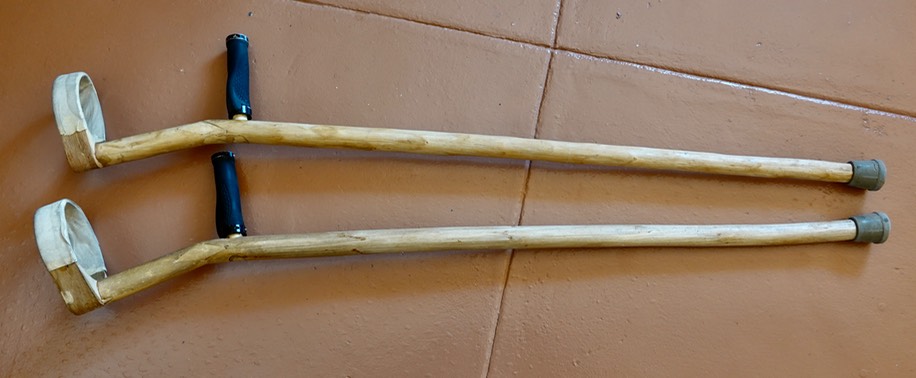
A couple of weekends ago, Bob Shipley stopped by the house to show us his new crutches. He had designed and made the forearm (aka elbow or Lofstrand) crutches from yucca, using other materials only as described below.
Most of us have walked the dry areas of the west and, thus, we know yucca. It may come in multiple species but the canes of all these plants, which are the flower stalks, are light in weight. We have picked them up, marveled at how something so light could be so resilient. We may even have crashed a cane against a rock to see how it splintered. On occasion we may have used one as a temporary walking stick. Bob had made his crutches from canes of this type. My first thought was that his effort might not be a good idea.
It is not that Bob shows up at the house anytime he has new crutches to show off. He is providing material for an article in the July 2026 issue of The Black Range Naturalist, on how he uses yucca in his art. He now lives in Albuquerque but lived in Kingston in the past and was making the rounds in the area - so why not show me his new crutches.
Bob is an engineer and a craftsman. Both skill sets are required for the art which he makes. He also knows how to describe his work in terms which people like me, who are neither engineers nor craftsmen, can understand. So one of the first things he did was tell me the crutches were made from yucca. My eyes immediately went to the bend in the crutches. I thought I caught a hint of a smile in the corners of his eyes.
He handed me the canes, “Yes Bob, they are very light." Perhaps I possessed the stuff of engineers after all, I could really tell they were light. And that they were truly made from yucca stalks. Yucca stalks which splinter rather too easily for me to think of them as crutches.
He took the crutches back, slipped his arms through the cuffs and put all of his weight on them. I wondered about my homeowners insurance. Then he handed them to me and insisted that I put my arms through the cuffs and put all my weight on them. I wondered about my medical insurance. I put all my weight on the crutches, no splintering. In fact, they were really comfortable, very light, they were like feathers at the end of my arms.
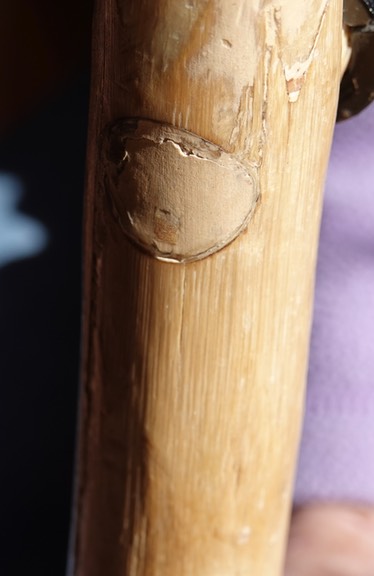
He took them back. I asked about the joinery where the hand grip joined the cane. The joint, pictured at the right, was fairly straightforward. This also gave me a chance to pay attention to the hand grip. The grip and the plastic/rubber “foot caps” are the only - except for the cuff, we will get to the cuff in a moment - parts of the crutches which are not yucca (except for some type of adhesive).
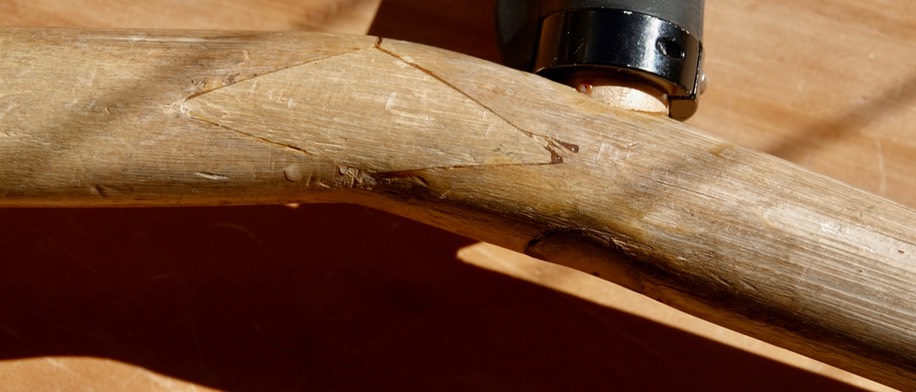
Noting how much I admired the joinery, he showed me another bit of work. This was the tour de force. That bit of yucca shaped like a squashed rectangle was what made the crutches “work”. This joint is necessary to create the 160° obtuse angle which mimics the natural bend of the elbow when it hangs straight. It was absolutely brilliant.
Crutches are typically made from lightweight aluminum, tubular steel, heavy-duty wood, or carbon fiber. These materials are used to minimize weight, maximize strength, and minimize cost. Crutches which break are not useful.
Breaking crutches brings us back to yucca crutches. Turns out that yucca is very strong in compression. When you place weight on something the load must be distributed in some fashion. Often the force of that weight is channeled to the ground (down the yucca shaft in this case). The ability of a material to withstand compression is called its compression strength (in materials). In compression the material is compacted, pushed together - as opposed to tension where the material is being pulled apart (think stretching a rubber band). When you place your weight on crutches you place compression on the shaft of the crutch - that is as far into engineering theory as we need to go for our purposes.
So my initial concern about the bend, the glance that caught Bob’s eye, was about to be addressed - with great glee, I might add.
The joint of the two pieces of yucca and the shape of the material used in the joint (a “rectangular wedge” created by Engineer Scientist Barry Spletzer specifically for this application) effectively align the force of compression with the structural character of the yucca. In other words, the downward force starts from the top of the crutch and is then refocused down the long part of the shaft - instead of being allowed to continue in a straight line. This ingenious craftsmanship and the attachment of the main load bearing element, the handle, on the straight part of the shaft address the limitations of yucca well and result in an optimal engineering design.
The cuffa are the other parts of the crutches which are not yucca. The cuffs were made of thin strips of oak soaked, rough formed over a hot pipe, and clamped around a custom-made form. Then the oak was laminated into a "sandwich" with a strip of chamois in the middle and bonded with Tightbond II adhesive. Oak will bend when properly treated and can be shaped, yucca will not.
And thus, a pair of forearm crutches evolved. A beautiful melding of form and function, made of sustainable materials. Art and science in one object.
And strong. Did I mention that Bob threw his crutches on the floor to demonstrate how strong they were? The man has flair.